Insights from the Institute for Government's first Making a success of Local Government Reorganisation: ‘Footprints’ for new unitary authorities
10
March
2026

Author
Emma Carson
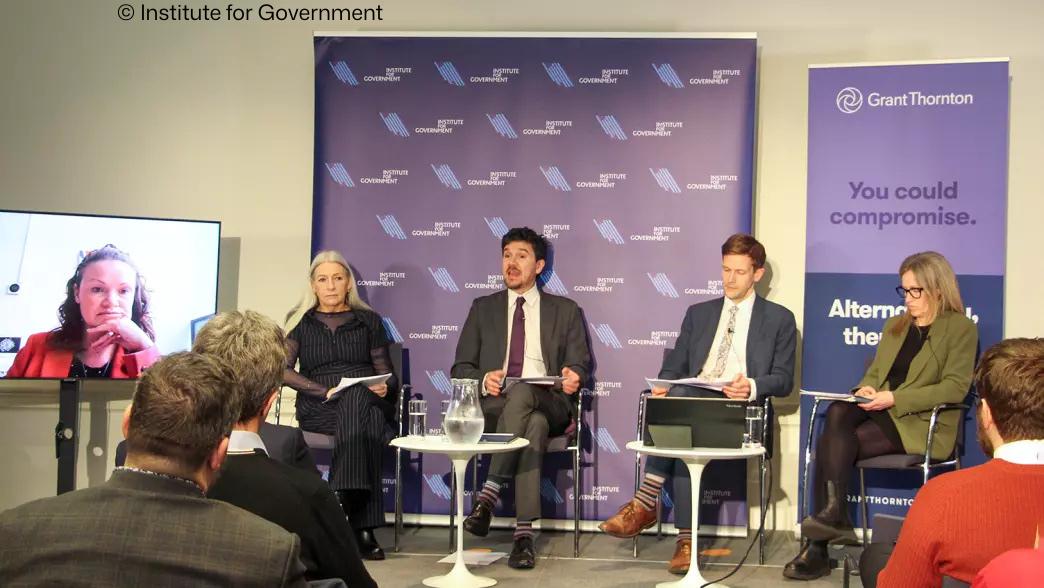
Last week we attended the Institute for Government’s (IfG) event on how ministers should decide the size and shape of new unitary authorities. The Government’s ambitious local government reorganisation (LGR) programme will replace all county and district councils with a single tier of unitary local government.
For those delivering projects in the built environment in England, the session highlighted that LGR is not just a governance story. It is likely to reshape who you engage with, how planning decisions are made, where political risk sits and how quickly local authorities can resource deliver at the same time as they are being asked to implement devolution reforms.
What we heard: no ‘one size fits all’ solution, but a clear decision framework will matter
The session opened with an overview of the decision-making framework. Ministers are assessing proposals against six criteria, supported by 21 sub-criteria. In practice, the test is whether proposed footprints create coherent economic areas that can support collaboration on strategic projects, deliver efficient and financially resilient services, avoid fragmentation, strengthen community engagement and are backed by robust evidence of local support.
Population size was a focal point on the panel, with a clear key message that thresholds are guide and not an answer. The IfG’s analysis notes a minimum population of 500,000 as a stated guiding principle, while also highlighting that ministers can accept different footprints where there is strong justification.
Two local perspectives:
Councillor Bella Sankey (Leader of Brighton & Hove City Council) outlined the case for five medium sized unitary authorities of around 300,000-400,000 residents to balance economies of scale with local accountability, align with economic geography and supporting fair representation with future devolution arrangements.
Councillor Kay Mason Billig (Leader of Norfolk County Council) made the case for a single unitary authority. With 85% of services already delivered at County level, she argued that scale brings financial resilience, reduces duplication, and she suggested that local voice protections can be addressed through strong community governance structures beneath the unitary authority.
Our takeaway: both models could work within the national framework. What will likely matter most is the strength of the evidence, the political manageability of the footprint and how convincingly it supports devolution.
Savings: Possible, but not guaranteed
Discussion then focused on the evidence for efficiencies. Consolidating senior leadership and back-office functions can create savings, but evidence suggests the link between authority size and efficiency varies by service. Structural change alone does not guarantee savings, delivery and implementation will be critical.
For planning and project delivery, the potential is clearer. If efficiencies translate into capacity, we could see better resourcing for planning policy and stakeholder engagement, supporting stronger performance and faster delivery of obligations and local programmes.
Democracy and trust
Questions from the audience also raised concerns about democracy and trust: Would larger authorities weaken representation? Panellists acknowledged declining public confidence driven by long term funding pressures and rising demand. Better service integration was presented as one potential benefit of unitarisation that could ultimately improve outcomes and, over time, rebuild trust.
LGR and devolution
The panel largely viewed LGR and devolution reforms as complementary, with a clearer unitary map potentially creating a stronger foundation for mayoral strategic authorities. However, the IfG’s wider work on ‘dual delivery’ is also clear about the challenges: councils need dedicated programme capacity to deliver reorganisation and devolution while maintaining business as usual - and capacity is already stretched thin.

What this means for projects in the built environment sector:
- Stakeholder maps may change: Decision-making responsibility, political leadership, scrutiny arrangement and officer teams can all shift. Build a resilient engagement plan that is not overly dependent on a single authority structure.
- Expect uneven planning performance during the transition: Reorganisation will absorb time and attention. Build contingency into programmes, especially where consenting depends on timely policy work, committee cycles or statutory consultation.
- The “strategic layer” may strengthen: Devolution linked structures are likely to put more weight on strategic planning, growth priorities and cross boundary infrastructure, which can be an opportunity to align project narratives to regional outcomes such as jobs, supply chain, investment and regional resilience.
Our key takeaways
Size matters but not in isolation. The footprint decision is ultimately a balance of service resilience, democratic connection and the credibility of delivery plans, not a single population number.
LGR should be viewed as a live project risk and opportunity; ensure your stakeholder mapping is clear and up to date and ensure engagement approaches can flex as structures evolve, and capacity resets.
Want to explore what this means for your project pipeline? Get in touch with the team to discuss the LGR implications.
The full event can be watched on the IfG’s YouTube channel here: https://youtu.be/_B128wQLa4o
Image credit: Institute for Government
Author
Emma Carson
Share


